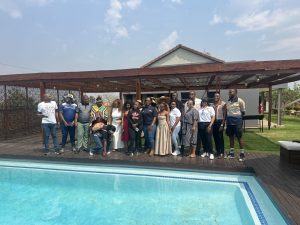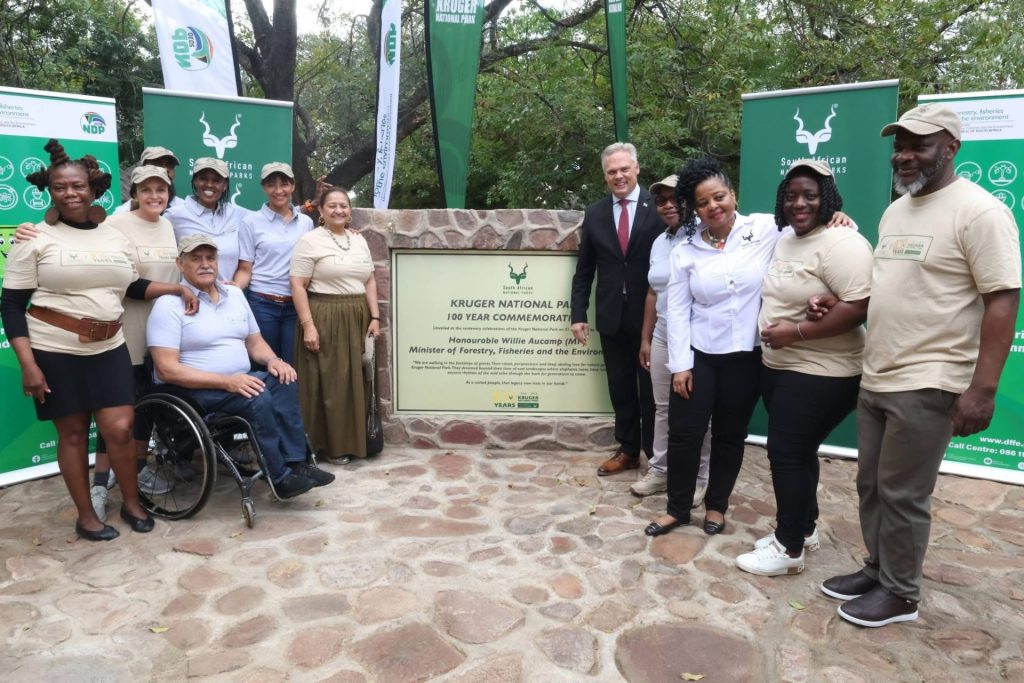
Pic: Minister Aucamp and officials from KNP and SANParks
By Lwazi Raul-Shongwe and Kopano Dibakwane
The Minister of Forestry, Fisheries and the Environment Willie Aucamp told guests at the Kruger National Park Centenary Commemoration in Skukuza, on Saturday night 30 May 2026, that the KNP(Kruger National Park) isn’t policy. It’s personal. It’s a Satara amphitheater movie with his brothers. It’s a lion-spotting contest from the backseat. It’s the spot just north of Letaba where he asked his wife to marry him.
“That is why, to this day, I remain deeply passionate about this place. The Kruger National Park is not merely a conservation area; it is a living classroom, a source of inspiration, and a national treasure that has touched the lives of generations of South Africans,” said Aucamp.
On 31 May 1926, the central section was added to link the Sabie Game Reserve and Shingwedzi Nature Reserve, officially forming the Kruger National Park. One hundred years later, the Park marked its centenary not just by looking back, but by adding a fourth leg to the table.
“There was a delicate balance that was forged, a delicate balance between conservation, scientific research and tourism, which are the three legs that formed the basis of the management of the Kruger National Park,” Aucamp said.
“We have now added a fourth leg, which is community involvement and as you would agree with me, any table with four legs is more stable than one with three. This will be the future of the Park,” said Aucamp.
A Signature That Changes Lives
The new leg was cemented a day before the gala dinner. “Ladies and gentlemen, yesterday was another milestone for the Kruger family as we signed the Beneficiation Agreement with all of the seven land claimant communities,” Aucamp said.
“This agreement will not only improve the socio-economic outcomes of these land claimant communities, but will ultimately be the beginning of creating more memories for other youngsters from all walks of life,” he added.
For decades, communities who live on Kruger’s boundaries have reportedly had a complex relationship with the Park. The Beneficiation Scheme is said to be focused on making the necessary shift.
“Conservation must exist within society. It must contribute to sustainable livelihoods. It must support development. And it must reflect the values of inclusion and dignity,” Aucamp affirmed.
“This milestone agreement now enables us to drive transformation in the biodiversity sector by promoting the rights, ownership, participation, and responsibilities of all stakeholders,” he added.
Walking in the Footsteps of Giant
The evening honoured the people who built Kruger’s legacy. “Over the last 100 years, there were remarkable people that contributed to the legacy and heritage of the Kruger National Park,” Aucamp said.
“People like James Stevenson-Hamilton, Harry Wolhuter, David Mabunda, Nombolo Mdluli – after whom this venue we are sitting in is named after, Dr Tol Pienaar, whose son Danie is the Head of Conservation and is also with us tonight, and Oscar Mthimkulu — you are a giant,” Aucamp declared.
Long service awards and posthumous recognition were given to “giants in whose footsteps we are now walking.”
Aucamp also thanked partners who have carried the Park through storms, literal and figurative.
“Earlier this year, I was here for a management meeting with the Kruger National Park team. We received warnings about the imminent heavy rains and immediately, everyone sprung into action. There was not a single fatality despite the huge visitor numbers,” he said.
Aucamp said when the Park needed help rebuilding, Tourism Minister Patricia de Lille responded.
“I phoned Minister de Lille and asked for help – she called me within a couple of days to confirm that Tourism would contribute R56-million in EPWP funding towards the recovery efforts.
“We now have established the Kruger Recovery Fund through which we are raising funds to begin rebuilding of climate resilient infrastructure,” he added.
The Next 100 Years
He said the tapestry of the Kruger National Park’s story is one that was woven with threads of conservation, resilience, and the enduring bond between people and nature.
“In 1898, the then-President Paul Kruger gave the instruction that this area should be declared a Conservation area, which led to the establishment of the Sabie Game Reserve. Later on, in the North, the Shingwedzi Nature Reserve was established.
“ Then on the 31st of May 1926, the central part of the Kruger National Park was added which connected the Sabie and the Shingwedzi Reserves to officially form what we now know as the Kruger National Park,” said Aucamp.
According to Minister Aucamp, the centenary calls not only for reflection and celebration, but it also demands clarity. Clarity about where the country comes from and where it is going.
“We are clear that the future of conservation in South Africa lies with inclusive stewardship. A responsibility that we all have to take on,” said Aucamp.
As the evening closed, Aucamp returned to the personal.
“Looking back on the last 100 years, I realise that we are walking in the footsteps of giants. Their vision, perseverance and deep abiding love for nature gave us the Kruger National Park.
“ They dreamt beyond their time of vast landscapes where elephants roam, lions rule and the ancient rhythms of the wild echo through the bush for generations to come. As a united people, that legacy now rests in our hands,” Aucamp said.
The event was attended by Minister of Tourism Patricia de Lille, Deputy Minister Bernice Swarts, Mpumalanga Premier, Mandla Ndlovu, the Chief Executive Officer of SANParks(South African National Parks), Hapiloe Sello, Traditional Leaders, and representatives from neighbouring reserves including Sabie Sands, Mala Mala, Timbavati and Klaserie.