September 2, 2026
fc930e1a-9b62-4c61-b233-d6b3743721c4

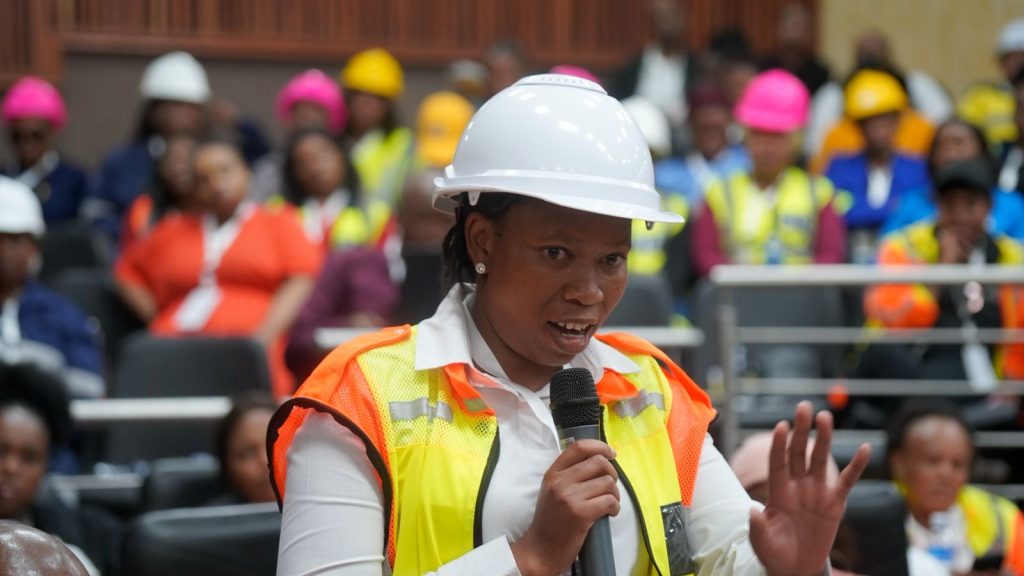
Pic :Caption: A delegate calling for meaningful women participation in construction

By Kopano Dibakwane
The Mpumalanga Provincial Government is deliberately turning concrete and tar into economic power for women, with the DPWRT (Department of Public Works, Roads and Transport) now awarding 57% of its contracts to women-owned enterprises.

This revelation was made by Mpumalanga MEC for DPWRT, Thulasizwe Thomo, at the Women in Construction Dialogue convened by the Office of the Premier in partnership with Provincial Treasury, CoGHSTA(Department of Cooperative Governance, Human Settlements and Traditional Affairs), as well as DPWRT.

In his keynote speech, MEC Thomo highlighted the significance of the Dialogue as it extends beyond commemorating Women’s Month.

“ It reflects a deliberate policy position of the Mpumalanga Provincial Government that economic transformation cannot be achieved if women remain underrepresented in sectors that drive public investment, industrialisation and infrastructure-led growth,” said Thomo.
The MEC was frank about the barriers women still face. He said construction is one of the largest contributors to economic development, creating employment, stimulating local economies, developing productive assets, and unlocking opportunities across the entire value chain.
He lamented the low participation of women in the sector despite progressive constitutional provisions, transformative legislation and procurement reforms.
The MEC said this year’s theme, “Building Inclusive Infrastructure and Expanding Opportunities for Women,” challenges government to adopt a different approach.

According to Thomo, Women continue to experience structural barriers that limit access to finance, procurement opportunities, technical skills, professional networks and leadership positions within the built environment,” said MEC Thomo.

He said government had resolved that the challenges facing women in construction cannot be resolved through policy instruments and talk alone. Thomo affirmed that the challenges require sustained institutional collaboration, measurable interventions and engagement on a continuous basis.

“It is against this background that, we commend the Office of the Premier, for having resolved to institutionalise the Women in Construction Dialogue as an annual provincial platform for policy engagement, accountability and implementation,” said MEC Thomo.

“It challenges us to ensure that infrastructure development is not only measured by the kilometres of roads we construct or the number of public facilities we deliver, but also by the extent to which those investments transform ownership patterns, create sustainable enterprises and expand economic opportunities for women,” Thomo added.

The MEC reminded delegates that last year’s dialogue at the Ehlanzeni Disaster Management Centre on 19 August 2025 adopted a clear implementation agenda whereby a commitment was made to strengthen procurement opportunities for women-owned enterprises, improve access to development finance, expand mentorship and enterprise development programmes.

“Importantly, we agreed that the Dialogue should not become an annual conversation without measurable outcomes. Instead, it should serve as an accountability mechanism through which Government reports on progress,” Thomo said.

Reporting on the progress made, MEC Thomo announced that during the 2025/26 financial year, the Department of Public Works, Roads and Transport awarded 45% of its contracts to women-owned enterprises, while COGHSTA achieved 32%.

“This momentum has continued into the current financial year. During the first quarter of 2026/27, Public Works, Roads and Transport increased the proportion of contracts awarded to women-owned enterprises to 57%, while COGHSTA reached 42%,”he said.
But he warned that percentages alone are not victory. According to Thomo, these figures are a reminder that transformation is a continuous process rather than a destination.
“ The objective is not merely to increase statistical representation, but to develop sustainable, competitive and resilient women-owned construction enterprises,” he said.

Thomo pointed to broader transformation in government, citing the 67% of the total workforce constituted by women across the Provincial Administration, which represent 46% of the Senior Management Service and account for 50% of all Heads of Department.
“I therefore encourage robust, honest and solutions-oriented engagement. Let this Dialogue critically assess the progress made since 2025, identify remaining constraints, and chart a practical programme of action,”he said.
“Together, let us ensure that the 2026 Women in Construction Dialogue becomes another significant milestone in building an infrastructure economy that is inclusive, competitive and reflective of the full potential of the women of Mpumalanga,” MEC Thomo Concluded.
MEC Thomo was accompanied by senior Provincial Government officials and key stakeholders including;
 the Executive Mayor of Steve Tshwete Local Municipality, Petrie Mhlonishwa, Members of the Executive Council, Chairperson of Buscor, Dr Norah Fakude, Members of the Provincial Legislature, Provincial Director-General, Maggie Skosana, Leadership of SAWIC(South African Women in Construction), CIDB(Construction Industry Development Board), and NHBRC(National Home Builders Registration Council), to mention but a few.

Leave a Reply

Your email address will not be published. Required fields are marked *