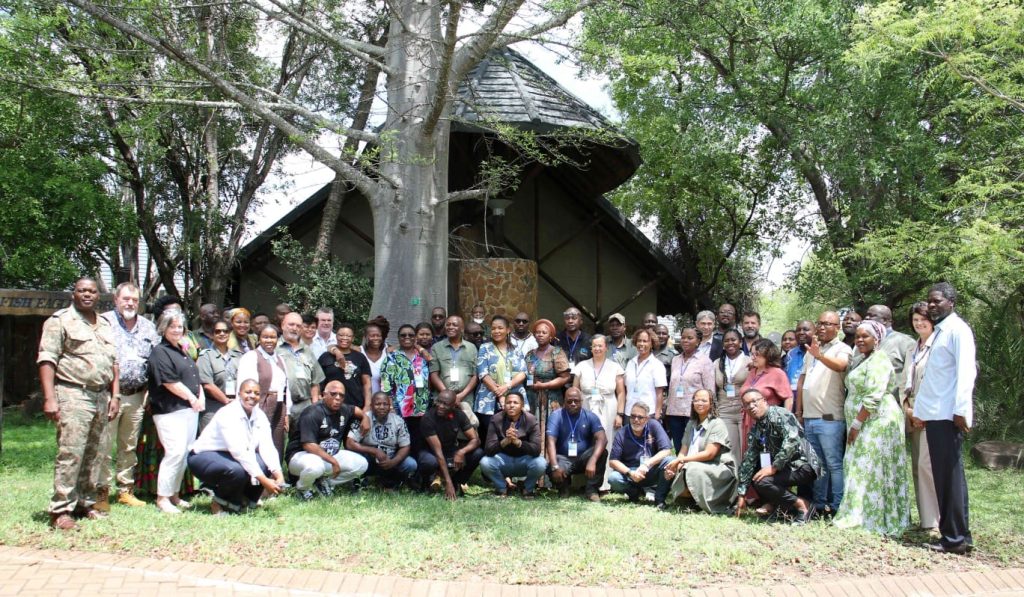
Caption: Delegates who took part at the Heritage and Museums Symposium
By Lwazi Raul-Shongwe and Kopano Dibakwane
Most visitors passing through the gates of the KNP (Kruger National Park), the mission might be simply to spot a lion in the tall grass,watch a herd of elephants cross the Sabie River, or catch a glimpse of a leopard draped over a marula branch.
For a century, the world-renowned reserve has been celebrated primarily as a triumph of wildlife conservation.
Yet, beneath the acacia trees and along the winding riverbeds lies another, far older story, one written in ancient stone walls, ochre rock paintings, and the lived memories of the people who called this land home long before boundaries were drawn on a map.
As the KNP marks its 100th year, SANParks(South African National Parks) is turning the spotlight onto this human tapestry.
From 10 to 11 November 2026, historians,
“It is a living cultural landscape that bears the footprints, memories, and histories of generations of people who have lived in, interacted with, and shaped this landscape,” he added.
For decades, the narrative of conservation in Southern Africa often treated wilderness areas as untouched, empty spaces.
The symposium challenged that view head-on, tracing a timeline of human ingenuity that stretches back millennia.
Delegates reportedly explored everything from the intricate San rock art tucked into granite shelters to the sophisticated Iron Age societies that once thrived in the region.
Louw said recent archaeological findings around Letaba, for instance, are rewriting regional history books, revealing sites that may predate the famous ancient kingdom of Mapungubwe.
Alongside a fresh look at the storied stone-walled citadel of Thulamela, these discoveries paint a vivid picture of complex trade networks, metallurgy, and thriving communities that existed centuries before the park’s 1926 proclamation.
To bridge the gap between academic research and the physical land, delegates reportedly stepped out of the conference room and onto the trails, visiting significant archaeological sites at Letaba and walking the Shilowa Trail to experience the cultural landscape firsthand.
However, celebrating a centenary also requires an honest reckoning with more recent, painful chapters.
The symposium did not shy away from the complex intersections of conservation, land dispossession, and South Africa’s liberation struggle, acknowledging how political and social dynamics have shaped the park and its neighboring communities over the last hundred years.
By bringing museums, researchers, and local heritage practitioners into the same room, SANParks aims to ensure that managing a national park means protecting its soul as well as its species.
“As we commemorate the Park’s centenary, this symposium provides an important opportunity to reflect on these shared histories, deepen our understanding of our heritage, and strengthen partnerships among heritage, museum, academic,
As Kruger National Park steps into its second century, it focuses on the true conservation about wholeness. Protecting the future of the wild means remembering, respecting, and telling the full story of the people who walked its paths first.