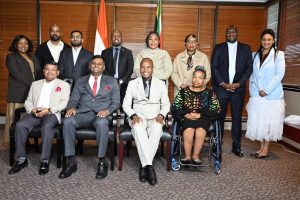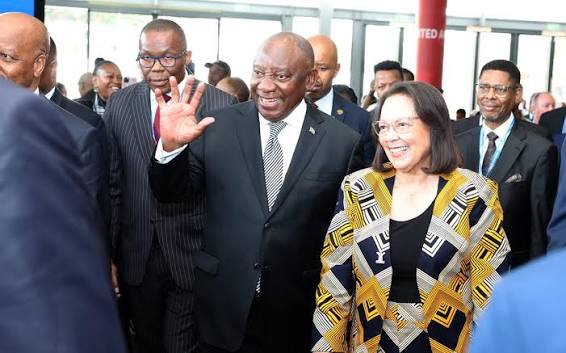
Caption:(left) President Ramaphosa alongside Tourism Minister, Patricia de Lille
By Lwazi Raul-Shongwe &Kopano Dibakwane
President Cyril Ramaphosa officially opened Africa’s Travel Indaba 2026 in Durban on 12 May 2026, using the platform to celebrate the tourism sector’s recovery and call for a more connected, diverse, and youth-driven African tourism industry.
“This is a city where cultures meet and where Africa gathers once again to tell its tourism story,” Ramaphosa told delegates at the Durban ICC. “Today, as we open Africa’s Travel Indaba 2026, we do so with a sense of pride.”
That pride, he said, comes from the resilience of the sector and the partnerships that carried it through some of the toughest years on record.
“Tourism is more than a sector of the economy. It is a living expression of who we are as a people.”
Recovery and Regional Travel
Ramaphosa pointed to strong numbers as evidence of renewed global confidence. Last year, South Africa welcomed 10.5 million international visitors.
Significantly, three-quarters of those arrivals reportedly came from the SADC region. “This tells us something important: Africans are choosing Africa.”
To build on that trend, South Africa is working with neighbours to advance the SADC Tourism UNIVISA for seamless, borderless travel, expand one-stop border posts, and develop cross-border itineraries.
“When Africans travel within Africa, we strengthen our economies, deepen our cultural ties and build a more integrated continent.”
Diversifying the Offering
The President highlighted new attractions aimed at broadening South Africa’s appeal beyond traditional safari and beach routes.
According to President Ramaphosa, Last month, government launched the upgraded Cape Agulhas Lighthouse precinct at the southernmost tip of Africa. In June 2025, the Kgodumodumo Dinosaur Interpretation Centre opened in the Free State’s Golden Highlands National Park, where the world’s oldest dinosaur embryo was discovered. “Since the launch of the centre more than 88,000 people have visited the site.”
He said two new cultural landmarks were unveiled around March in Durban; statues of Nelson Mandela and Oliver Tambo.
“This demonstrates the importance of expanding and diversifying our tourism offering, catering to a broad range of domestic and international travellers.”
Jobs, Youth, and Innovation
Ramaphosa stressed that tourism’s impact goes beyond statistics. The sector accounts for nearly one million direct jobs in South Africa, about 1 in 18 workers.
“The increases we have seen in tourism figures are not merely of statistical interest. They represent families supported, small businesses revived and communities that are being uplifted.”
He spotlighted youth and innovation as the future of the industry, citing township entrepreneurs, rural cooperatives, and young tech developers creating apps and safety tools.
“Our youth are not waiting for the future. They are creating it now. They are proving that tourism is not only about destinations but that it is about innovation, creativity and opportunity.”
Connectivity and Reform
The President credited South Africa’s G20 Presidency in 2025 with advancing priorities like sustainable tourism and infrastructure investment. During that year, the Electronic Travel Authorisation system was piloted and is now being rolled out to simplify entry for millions of visitors.
He said airline seat capacity has also grown, driven by African and Asian routes. New visa reforms, including the Digital Nomad Visa, are aimed at making travel easier and boosting competitiveness.
A Continental Vision
Ramaphosa framed the Indaba within Africa Month and the African Union’s Agenda 2063, which envisions free movement across the continent.
“Pan-Africanism is not only a political philosophy. It is a driver of economic progress. It is the foundation of our shared prosperity.”
He closed with a call to government, industry, communities, and youth to keep building the sector together.
“Every conversation at this Indaba, every partnership formed, every idea shared, these are the building blocks of a continent that is rising, confident in its potential and united in its purpose. Africa is not waiting. Africa is leading.”