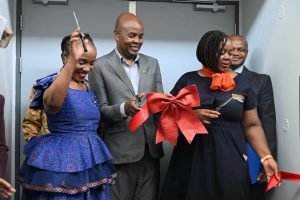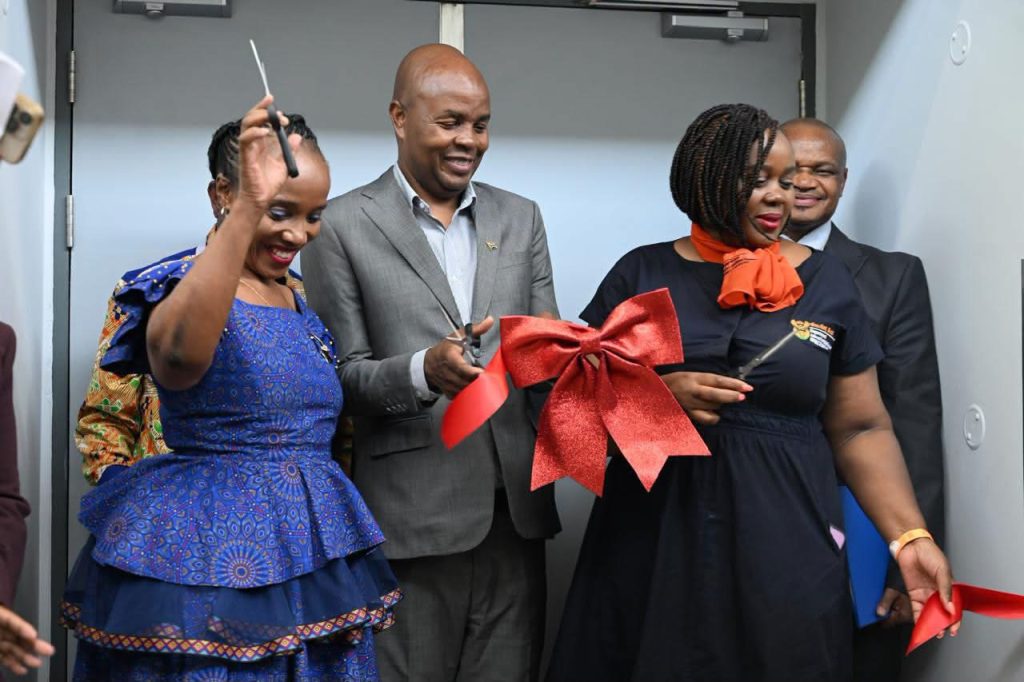
Caption:(from left) Minister Chikunga, Premier Ndlovu, and Minister Kubayi
By Lwazi Raul-Shongwe
In a province known as the Place of the Rising Sun, the shadows cast by GBV (Gender-Based Violence) have felt overwhelmingly long for many families.
Yet, on Friday 20 November 2026, a tangible ray of hope broke through at King Nyabela Hospital in Middelburg, where Mpumalanga officially opened its seventh TTC(Thuthuzela Care Centre).
Coinciding with the national launch of the 2026 16 Days of Activism for No Violence Against Women and Children, the opening was not merely a ribbon-cutting ceremony; it was a solemn reckoning with a crisis that has stolen mothers, daughters, and childhoods across the province.
For Mpumalanga Premier, Mandla Ndlovu, the statistics are deeply concerning.
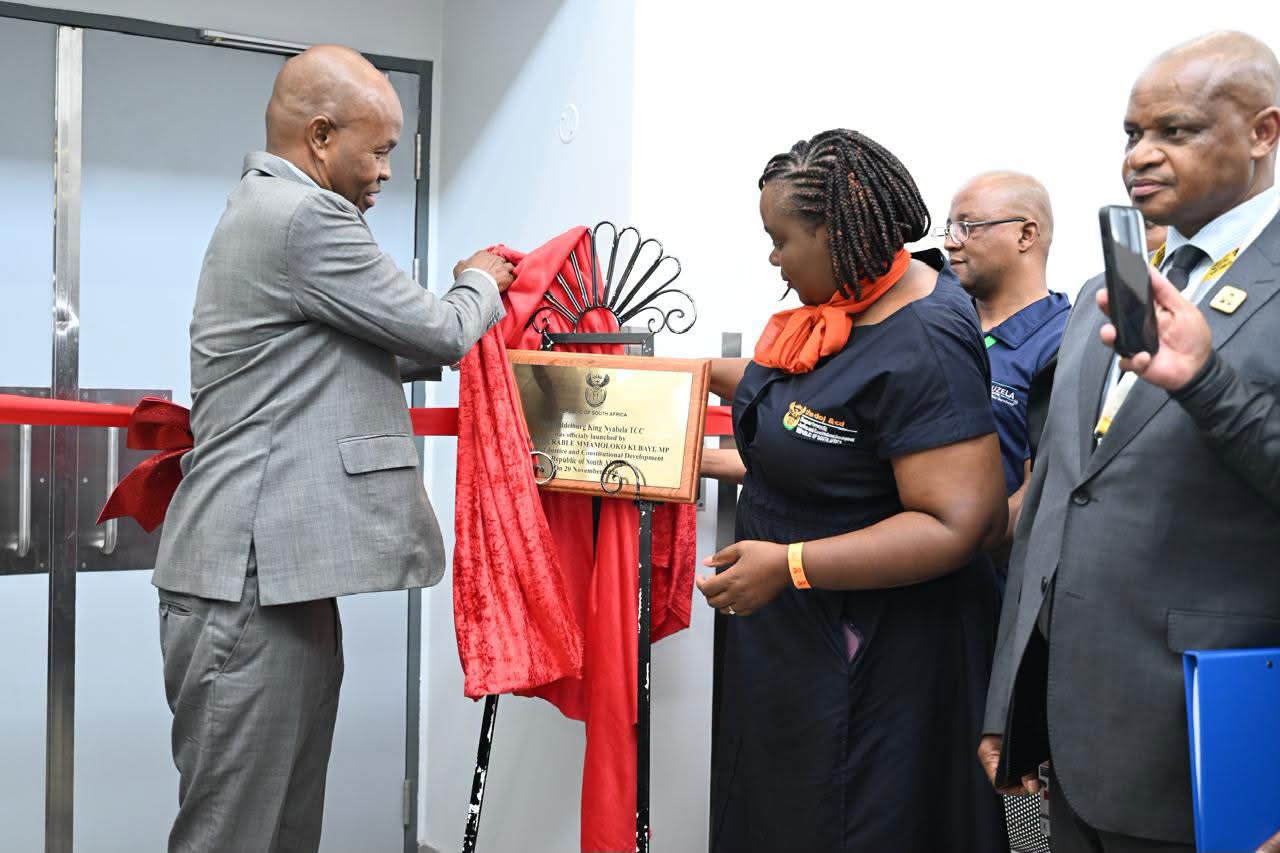
Addressing a gathering of traditional leaders, justice officials, and community members, including Deputy President Paul Mashatile, the Premier spoke not just as a politician, but as a father haunted by the daily anxieties facing South African families.
“As a father, I understand that fear, that when our children leave for work, school, or an early morning run, they might not return,” Premier Ndlovu shared candidly in isiZulu, reflecting on the brutal murders of women and children across the country in September. “Unfortunately,
The weight of that grief was palpable as the Premier invoked the names of local women whose lives were cut short, Thembi Lukhele of Bethal, Goodness Mandlazi, and Kedibone Sigudu of eMalahleni.
Behind their names lie stark realities. Between January and March 2026 alone, 900 sexual offences were reported to Mpumalanga police, a figure the Premier acknowledged only scratches the surface of unreported trauma.
Even more heartbreaking is the province’s struggle to protect its youngest girls, with alarming rates of girls aged between 10 and 14 giving birth, a crisis Ndlovu urged communities to confront by reporting perpetrators directly to the police.
To break this cycle, Premier Ndlovu pointed to the invisible chains keeping many women trapped such as economic exclusion.
With female unemployment in Mpumalanga standing at 40.1 percent in the second quarter of 2026, financial dependence is often viewed as a contributing factor that forces women to endure abuse just to survive.
Speaking directly to the youth, the Premier delivered a passionate plea for independence and self-worth, urging young girls to prioritize their education rather than relying on “blessers” or staying in violent relationships “for the sake of a plate of food.”
He also challenged deeply ingrained cultural stigmas, reminding married women in Mpumalanga that their family homes will never turn them away if they need to escape abuse.
While the new Thuthuzela Care Centre at King Nyabela Hospital, joining six others at Tonga, Witbank, Evander,
“Our ultimate objective must be to build a society in which such violence is totally eradicated,” Premier Ndlovu stated.
He stressed that the true measure of the Middelburg center’s success “will not be measured merely by its establishment, but by whether survivors receive timely and dignified care, their rights are protected, and our institutions are better able to deliver justice.”
That bridge between trauma and justice was a central focus for the Minister of Justice and Constitutional Development, Mmamoloko Kubayi, who reportedly joined the Premier to outline the vital role these one-stop centres play in holding perpetrators accountable.
Highlighting the significantly higher conviction rates achieved in cases processed through TCCs, Minister Kubayi called for a Centre to be established in every district, noting that tailored local support is essential because “every community is different, and their needs are different.”
Minister Kubayi said that a building alone cannot heal a survivor; it requires a seamless chain of human compassion and institutional readiness.
From specially trained SAPS officers and dedicated NP(National Prosecuting Authority) prosecutors to attentive social workers and functioning medical equipment, every link must hold.
Beyond government intervention, the Minister invited ordinary citizens to play a direct role in softening the trauma for the youngest victims of abuse. She appealed to local communities and organisations to donate toys and books to the centre, offering small comforts to frightened children preparing to testify in court.
Held under the theme “Letsema: Men, Women, Boys and Girls Working Together to End Gender-Based Violence and Femicide,” the day served as both a memorial for lives lost and a rallying cry for collective action.
As Premier Ndlovu looked out over the Middelburg crowd, his closing prayer echoed the quiet determination of a community refusing to surrender to fear. “May the sun rise again, for women deserve to walk our streets without fear, for girls deserve to grow up in safety, and for survivors working to rebuild their lives.”
Other senior national and provincial officials such as Minister in the Presidency for Women, Youth and Persons with Disabilities, Sindisiwe Chikunga, Members of the Mpumalanga Provincial Executive Council, The National Director of Public Prosecutions, Adv Andy Mothibi, Mpumalanga Provincial Police Commissioner, Lieutenant-General, Apaphia Modise and all SAPS members, Chairperson of the Provincial House of Traditional and Khoi-San Leaders, who is also the President of CONTRALESA, Kgoshi Lameck Mokoena, and Amakhosi, Provinc